Updated: July 2026
Uluwatu vs. Canggu Investment: Which Bali Zone Outperforms in 2026?
Two zones. Different bets.
Uluwatu and Canggu are Bali’s most-asked-about investment markets. They are not interchangeable. Here’s the framework we use when allocating capital across the two. (See Indonesia Investment Coordinating Board (BKPM) for context.)
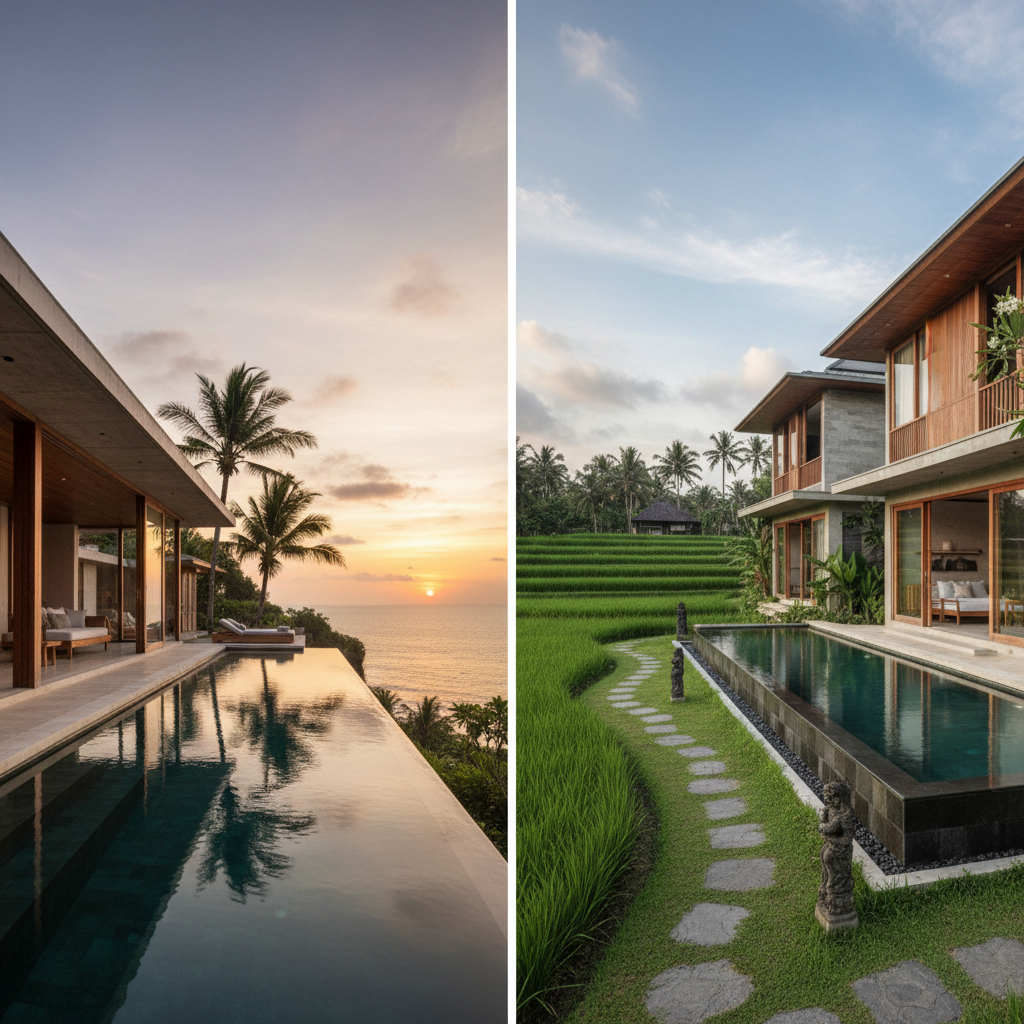
Almost every prospective investor we speak with has narrowed their first deployment to one of these two zones. The choice usually feels arbitrary — “I prefer Canggu’s vibe” or “I want clifftop, so Uluwatu.” After managing 80+ villas across both areas for the past nine years, we can say with confidence: the choice is not aesthetic. The two zones produce different financial outcomes, and both can be wrong for the same investor.
The yield difference
Canggu villas (specifically Berawa, Pererenan, and Babakan sub-zones) consistently produce higher net yields. Our 2024 portfolio numbers: 11.8% in Canggu vs. 9.2% in Uluwatu. The reason is straightforward — Canggu’s nightly rates are 30% lower, but occupancy is 10 percentage points higher, and operating expenses (staff, transport, supply logistics) are 25% lower because of denser support infrastructure.
If your KPI is annual net cash yield, Canggu wins. Full stop.
The capital appreciation difference
Uluwatu wins this dimension. From 2017 to 2024, our managed Uluwatu portfolio appreciated at 9.4% CAGR vs. Canggu’s 6.1%. The drivers: limited supply (cliffside zoning is finite), buyer profile (investors with $1M+ deployments target Uluwatu, not Canggu), and the gravitational pull of Six Senses, Bvlgari, and the new Aman that anchored the area.
If your KPI is total return (yield + appreciation), Uluwatu has historically produced 15.5% / yr vs. Canggu’s 17.9% / yr. Closer than most expect, with Canggu marginally ahead because of the yield gap.
The risk profile
Canggu’s risk: overdevelopment. The municipal moratorium on new villa construction in 2023 was a response to this. Investors entering Canggu now should assume nightly rates plateau or compress 10-15% over the next 36 months as previously-permitted units come online.
Uluwatu’s risk: capital lock-up. The exit market is thinner — you sell to one of perhaps 200 qualified high-net-worth buyers globally vs. Canggu’s 2,000+ active deal flow. Time-on-market for an Uluwatu villa is typically 9-18 months. Canggu transacts in 2-4 months.
Operational difference
Canggu is operationally easier. Staff retention, supply chains, contractor networks, marketing infrastructure — all denser, all faster. A Canggu villa can be turned around between guests in 3 hours. An Uluwatu villa typically needs 4-5 hours due to driving distances.
If you’re remote-managing your investment without local staff, Canggu is meaningfully more forgiving. Uluwatu requires either a property manager you trust completely or your own ground presence.
The framework
Pick Canggu if: you want maximum cash yield, you’ll hold 5-7 years, you value liquidity at exit, and your deployment is $400K-$800K.
Pick Uluwatu if: you want maximum capital appreciation, you’ll hold 7-12 years, you have $700K+ to deploy, and you value lifestyle utility (you’ll personally use the villa for parts of each year).
Build a portfolio across both if: you have $1.5M+ to deploy. The diversification across yield/appreciation profiles, zone-specific risks, and exit-market liquidity profiles is genuine.
Want our zone-by-zone allocation models?
We share these in our thesis deck. Reply with your investment range and we’ll send the relevant sections.
The salty air of the Indian Ocean, a gentle breeze rustling through frangipani trees, whispers not just of paradise, but of discerning investment opportunities taking root in Bali’s most coveted locales. For those eyeing the luxury villa market in 2026, the strategic choice between Uluwatu’s dramatic cliffs and Canggu’s vibrant shores hinges on understanding the nuanced shifts in high-net-worth traveler preferences and regional development trajectories.
The evolving landscape of luxury tourism and investor appeal
Bali’s luxury market has matured beyond mere aesthetics; today’s affluent traveler seeks not just an infinity pool, but an immersive, authentic, and often transformative experience. This evolution demands that bali villa investment strategies move beyond conventional metrics, focusing instead on properties that offer bespoke services, privacy, and a genuine connection to the island’s spiritual and natural allure. Investors must discern how each zone uniquely caters to this sophisticated demand, shaping future rental yields and capital appreciation.
Uluwatu, with its majestic limestone cliffs and world-class surf breaks, inherently offers a canvas for exclusive, retreat-style luxury. Properties here often emphasize privacy, expansive ocean views, and proximity to iconic cultural sites like the Uluwatu Temple, attracting a demographic seeking tranquility, wellness, and high-end culinary experiences in a serene setting. Canggu, conversely, has cultivated a dynamic, modern luxury scene. Its appeal lies in a sophisticated blend of high-end dining, boutique shopping, and a thriving international community, drawing a younger, trend-conscious affluent traveler and the burgeoning digital nomad elite who value connectivity and a vibrant social fabric alongside their opulent accommodations.
Dissecting rental yields and capital growth projections for 2026
From a financial vantage point, the investment performance of luxury villas in Uluwatu and Canggu presents distinct profiles. Uluwatu’s high-end, often larger and more secluded properties, command premium nightly rates, particularly those featuring unique architectural designs or oceanfront positions. These villas typically achieve robust seasonal rental yields, underpinned by their exclusivity and appeal to discerning guests seeking a serene escape. Capital appreciation in Uluwatu is largely driven by limited land availability in prime cliff-top locations and the consistent demand for truly exceptional, private estates.
Canggu’s market, while more competitive due to its rapid development, benefits from consistently high occupancy rates throughout the year. Its more contemporary, often smaller, luxury villas cater to a broader affluent market, including long-stay guests and digital nomads, ensuring a steady stream of rental income. Property values in Canggu are propelled by continuous infrastructure improvements, a burgeoning lifestyle scene, and a relentless influx of international residents and tourists. Luxury villas in prime Uluwatu locations have seen an average annual capital appreciation of 8-12% over the last five years, while Canggu, fueled by its dynamic growth, has often surpassed 15% in specific micro-markets. Average nightly rates for a 3-bedroom luxury villa in Uluwatu can reach upwards of $800 during peak season, compared to Canggu’s similar properties averaging around $550, though Canggu often boasts higher occupancy rates.
Infrastructure, sustainability, and the long-term investment horizon
Bali’s ongoing infrastructure enhancements are critical determinants of future villa investment success. Significant road upgrades and enhanced digital connectivity directly impact accessibility and desirability. The Denpasar-Gilimanuk Toll Road project, slated for partial completion by 2026, aims to significantly ease traffic congestion and improve access to the island’s western reaches. This development, while not directly within Uluwatu or Canggu, will enhance the overall visitor experience and logistics across Bali, indirectly benefiting both zones by making the entire island more accessible and attractive.
Beyond traditional infrastructure, sustainability has emerged as a non-negotiable criterion for the modern luxury traveler and, consequently, for astute investors. Villas that integrate eco-friendly designs, harness renewable energy sources, and implement sustainable operational practices—such as comprehensive waste management systems and local sourcing for amenities—not only attract a premium clientele but also future-proof their investment. These practices align with global luxury tourism trends and position properties favorably against evolving market demands and potential environmental regulations.
Ultimately, the enduring appeal of Bali as a destination for luxury tourism and bali villa investment is deeply rooted in its rich cultural heritage and natural beauty. The island’s status as a UNESCO World Heritage Cultural Landscape underscores its unique value. Investors who understand and integrate local culture, environmental stewardship, and community engagement into their projects will secure not just financially rewarding assets, but also resilient and respected properties that resonate deeply with the discerning luxury traveler of 2026 and beyond.


