Updated: July 2026
How Much Does Investing in a Luxury Bali Villa Truly Cost?
- Land & Build: The initial outlay covers land acquisition (typically long-term leasehold), architectural design, and high-specification construction, which can exceed $1,500 per square meter.
- Fit-Out: A significant portion, often $250,000+, is dedicated to luxury furnishings, imported appliances, custom millwork, and professional landscaping.
- Operational Costs: Owners should budget 8-12% of the property’s value annually for staffing, maintenance, utilities, and management fees.
The warm, humid air carries the scent of frangipani and incense from a nearby temple offering. Underfoot, the smooth, cool terrazzo gives way to the warm grain of a teak deck. You are standing on the lanai of a prospective villa plot in Pererenan, the turquoise slash of the infinity pool already mapped out in your mind, the sound of the Indian Ocean a low, constant hum just 300 meters away. This is the Bali dream, a potent cocktail of sensory delight and profound tranquility. But as a discerning investor, you know the romance must be underpinned by rigorous financial reality. Moving beyond the curated Instagram feed, what does it genuinely cost to bring a world-class luxury villa to life on this island? The answer is more complex than a single sticker price; it’s a mosaic of land tenure, construction variables, operational logistics, and legal nuances. Let’s peel back the layers. (See Indonesia Investment Coordinating Board (BKPM) for context.)
Deconstructing the Purchase Price: Land, Location, and Legality
The foundational cost of any villa project is the land itself, and in Bali, this is a conversation that begins with legal structure. As a foreign national, you cannot directly own land under a Freehold (Hak Milik) title. The most secure and common structure for investment is establishing a foreign-owned company, a PT PMA, which can then hold a Right to Build (Hak Guna Bangunan or HGB) title, or more commonly, secure a long-term leasehold (Hak Sewa) for 25 to 30 years, often with extensions pre-negotiated. According to Adrian Santoso, a leading property lawyer in Jakarta, “The PT PMA structure is the gold standard for foreign investors, providing legal clarity and a framework for repatriation of profits.” Location dictates the price of this leasehold land dramatically. In the prime coastal belt of Canggu and Pererenan, expect to pay between $1,500 and $2,500 USD per are (100 square meters) per year. A 10-are plot (1,000 square meters), a standard size for a four-bedroom luxury villa, could therefore command a 30-year lease premium of $450,000 to $750,000 upfront. Move south to the limestone cliffs of Uluwatu, and prices hover between $1,200 and $2,000 per are. For a more serene, jungle-facing property near Ubud, the cost might decrease to $800 to $1,500 per are. Before any contracts are signed, a thorough due diligence report by a reputable notary is non-negotiable, costing between $1,500 and $3,000 to verify zoning, ownership history, and access rights.
The Art of the Build: From Architectural Vision to Turnkey Reality
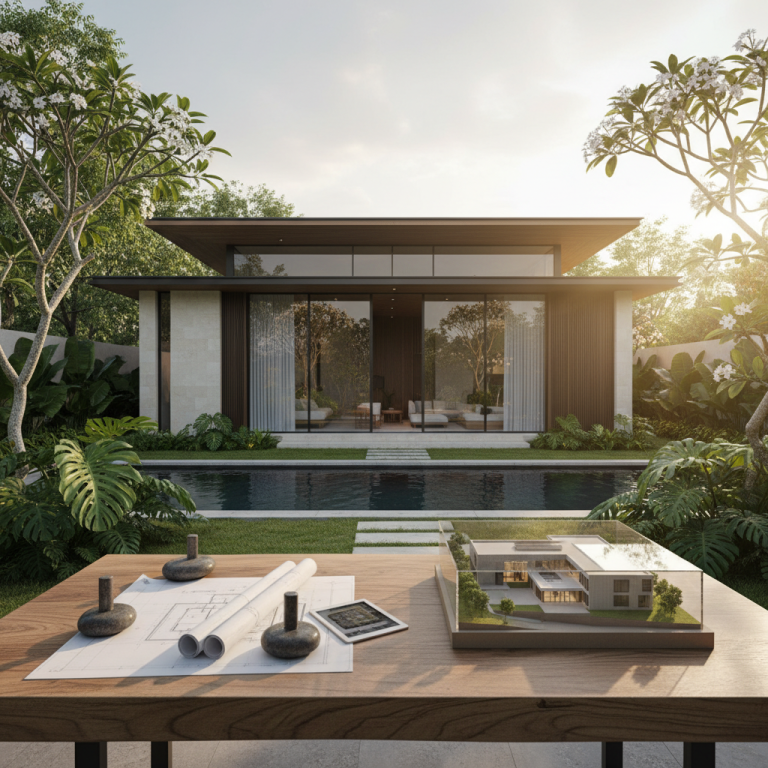
With land secured, the next major capital outlay is the physical construction. This is where the term “luxury” is truly defined and paid for. For a high-specification build in Bali, the all-in cost ranges from $1,200 to $1,800 USD per square meter of built-up area. A spacious 500-square-meter villa, encompassing indoor and outdoor living spaces, would therefore have a construction budget of $600,000 to $900,000. This price reflects the use of premium materials: aged Ulin ironwood for decking, custom-poured terrazzo floors, Italian marble for countertops and bathrooms, and high-performance, floor-to-ceiling glass. Architectural fees, typically calculated as 5-7% of the total build cost, are a critical upfront investment for a design that maximizes both aesthetic appeal and rental potential. A world-class infinity pool, a prerequisite for any luxury rental, is a project in itself, with costs for a 15-meter, fully tiled pool with a high-end filtration system ranging from $40,000 to $70,000. Landscaping, crucial for creating the private oasis feel, can easily add another $20,000 to $50,000, involving mature palm trees, water features, and sophisticated lighting design. The entire process, from groundbreaking to handover, typically spans 12 to 18 months, a period during which capital is deployed without any incoming revenue.
Furnishings and Fit-Out: The Quarter-Million Dollar Interior
A beautifully constructed villa is merely a canvas; the Furniture, Fixtures, and Equipment (FF&E) are what transform it into a premium, revenue-generating asset. This is a line item frequently underestimated by new investors. As Paris-based interior designer Isabelle Dubois, who now works exclusively on Bali projects, notes, “The FF&E budget is what separates a good villa from a great one. It’s the tactile experience—the weight of the cutlery, the thread count of the sheets, the ergonomics of the lounge chairs. This is where you achieve the ‘wow’ factor that commands a $1,500 nightly rate.” For a 4-5 bedroom luxury property, a realistic FF&E budget starts at $250,000 and can easily exceed $500,000. This includes custom-designed and locally crafted teak furniture, a curated collection of Indonesian art and artifacts, a fully equipped kitchen with appliances from brands like Gaggenau or Miele, and state-of-the-art electronics, including SONOS sound systems and smart TVs in every room. Importantly, any imported items are subject to Indonesian import duties, which can be as high as 40% of the item’s value. Sourcing high-quality linens, professional-grade kitchenware, and unique decorative objects is a significant undertaking that requires deep local knowledge and supply chain management, a key service provided by a comprehensive Bali Villa Investment firm.
The Invisible Costs: Licensing, Taxes, and Professional Fees
Beyond the tangible costs of land, construction, and furniture lie a host of “invisible” expenses that are critical to operating legally and efficiently. Securing the correct licenses is paramount. The initial building permit, formerly the IMB and now the PBG (Persetujuan Bangunan Gedung), is a complex bureaucratic process that can cost between $10,000 and $25,000 and take several months. To legally operate as a short-term rental, the property requires a specific tourism license, known as a Pondok Wisata or Villa License. The application process for this can cost an additional $5,000 to $15,000. Then come the taxes. The annual Land and Building Tax (PBB) is relatively modest, but rental income tax is a significant consideration: a 10% final tax for Indonesian tax residents or a 20% withholding tax for non-residents. Furthermore, a Value Added Tax (PPN) of 11% applies to most services, including management fees. A prudent investor will budget 5-8% of the total project cost for a team of professionals, including a notary, lawyer, tax consultant, and project manager. This professional guidance is essential for local regulatory environment, which you can learn more about via the official portal at indonesia.travel. These costs are not optional; they are the price of security and long-term viability for your Bali vill ai nvestment.
The Operational Ledger: Keeping the Dream Alive (and Profitable)
The final, and ongoing, piece of the cost puzzle is the operational expenditure required to maintain a luxury villa at a five-star standard. This is a full-fledged hospitality business, and it must be funded as such. The largest operational cost is staffing. A premium 4-5 bedroom villa requires a full-time team: a villa manager, one or two butlers, daily housekeeping, a gardener, a pool technician, and overnight security. This team of 6-8 full-time staff can represent an annual payroll of $60,000 to $100,000. Utilities are another substantial expense; with air conditioning, pool pumps, and lighting, the monthly electricity bill alone can be $1,500 to $3,000. Add in high-speed fiber internet, water, and waste management, and the total monthly utility cost can approach $4,000. A critical but often overlooked budget item is the sinking fund for Capital Expenditures (Capex). A prudent owner sets aside 1-2% of the property’s value each year for future replacements like roofs, generators, and appliances. On a $2 million villa, that’s $20,000 to $40,000 annually. Finally, if you employ a villa management company to handle marketing, bookings, and guest services, their fee will typically be 20-30% of the gross rental revenue. All told, the annual operational cost for a luxury villa can easily range from $100,000 to $150,000 before any profit is realized.
Quick FAQ: Your Bali Investment Questions, Answered
What is the typical ROI for a luxury Bali villa?
A well-managed luxury property in a prime location like Pererenan or Uluwatu can achieve net rental yields of 8% to 15% annually. For instance, a $2 million all-in investment might generate $350,000 in gross annual revenue. After deducting $120,000 in operational costs, the net operating income would be $230,000, representing an 11.5% net yield. This does not include potential capital appreciation of the asset, which has historically been strong in prime areas.
Can a foreigner legally own land in Bali?
No, foreigners are prohibited from directly owning land under the Freehold (Hak Milik) title, as stipulated by Indonesian Agrarian Law. The most secure method is to form a foreign-owned company (PT PMA), which can then acquire a “Right to Build” (HGB) title. This title is granted for an initial period of 30 years, can be extended for 20 years, and then renewed for another 30 years, providing a total of 80 years of tenure. For a broader understanding of Indonesia’s national governance, Wikipedia offers a comprehensive overview.
Are there culturally protected zones I should avoid investing in?
Absolutely. It is crucial to avoid investing in designated “green zones” (jalur hijau) or areas with strict building restrictions. This includes land in close proximity to major temples (Pura) and, significantly, land within the UNESCO World Heritage cultural landscape of the Subak irrigation system. A thorough due diligence process with a qualified notary will include a zoning check to ensure your intended plot is designated for tourism accommodation development.
The true cost of investing in a luxury Bali villa is a formidable figure, far exceeding the initial land and build price. It is a complex equation of legal setup, meticulous construction, sophisticated interior design, and, most importantly, a fully-funded, long-term operational business plan. The numbers are significant, but for the right investor, the returns—both financial and experiential—can be extraordinary. Navigating this landscape requires more than capital; it demands deep, localized expertise. To transform this detailed financial blueprint into your own piece of paradise, explore the bespoke services offered by our partners at Bali Vill Ai Nvestment. Their team provides the on-the-ground intelligence and execution capabilities necessary for a successful acquisition. For those ready to move from abstract figures to a concrete proposal, starting a conversation with a specialist in Bali villa investment is the definitive next step.